
ಶಾಶ್ವತ ಪಂಚಾಂಗ
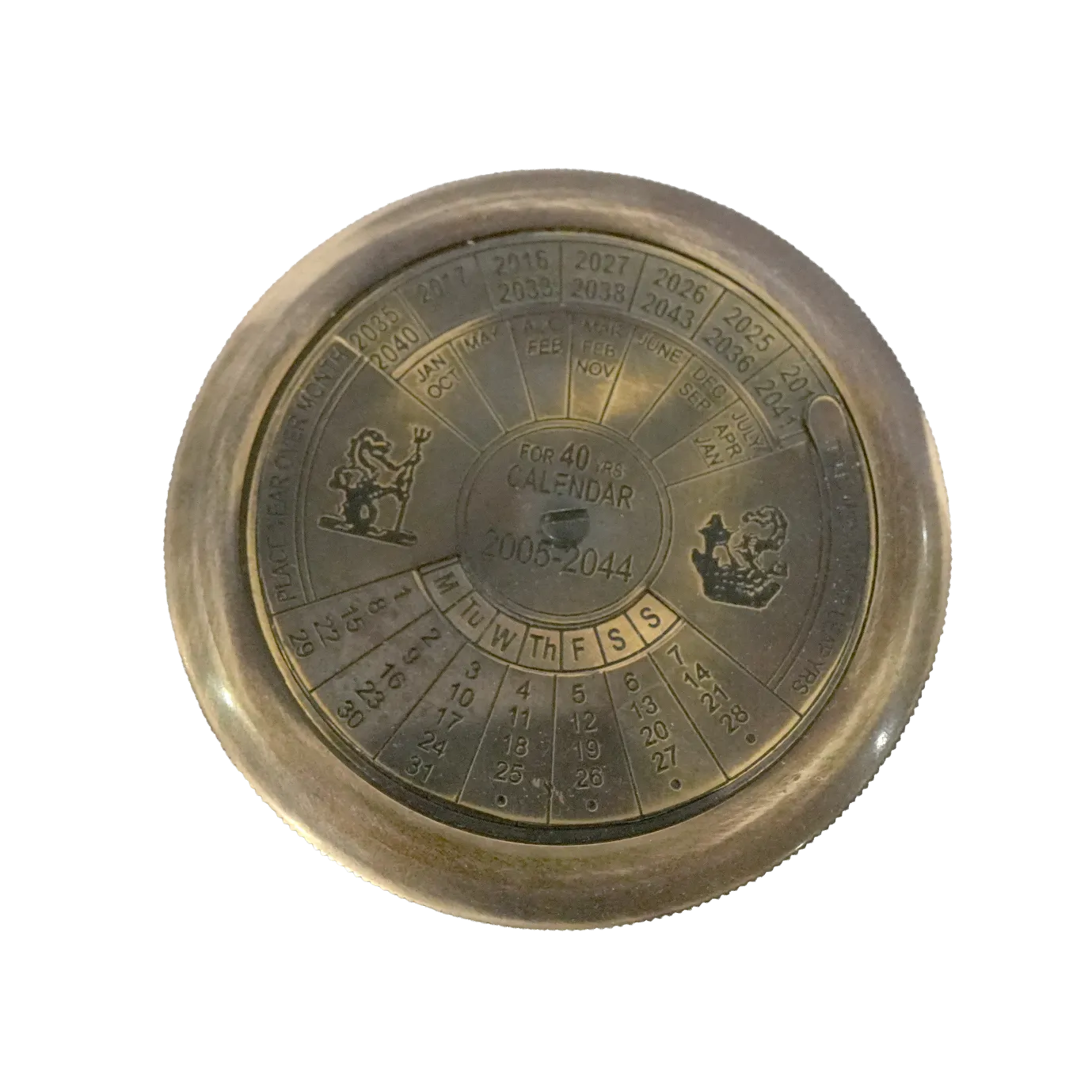
The Brass Perpetual Pocket Calendar is a compact mechanical timekeeping
instrument that demonstrates the ingenuity of pre-digital calendar calculation.
Crafted from brass, this circular calendar disc is engraved with concentric rotating
rings and is designed to determine the day of the week for any date between 2005
and 2044 without the need for batteries, electricity, or digital technology. The
instrument features a durable brass casing with a naturally aged patina, while its
engraved face displays years, months, dates, and weekdays arranged in a
mathematically precise format. By simply rotating the disc to align the selected year
with the corresponding month, the user can accurately identify the weekday for any
date within its forty-year range, including leap years through specially marked month
indicators. Decorative engravings, including a lion and a human figure, further
enhance its aesthetic appeal, reflecting the craftsmanship traditionally associated
with such precision instruments. Perpetual calendars of this type were widely used
by scholars, merchants, administrators, and professionals for planning events,
maintaining records, and verifying dates before the advent of electronic calendars.
They represent an important stage in the evolution of timekeeping, combining
mathematical principles with practical design in a simple yet highly effective
mechanical device. In India, the concept of perpetual timekeeping resonates with the
long-standing tradition of the Panchanga, the classical Indian almanac used to
determine auspicious dates and track the cycles of time. This brass calendar reflects
the meeting of traditional Indian calendrical knowledge with Western mechanical
innovation during the colonial and post-colonial periods, when such instruments
became popular for both personal and office use. Although digital calendars have
largely replaced mechanical versions today, the Brass Perpetual Pocket Calendar
remains an important historical artifact, admired for its precision, durability, and
elegant craftsmanship. Preserving this instrument in a college museum highlights the
evolution of scientific thought, mathematics, and mechanical design while enabling
students to appreciate how earlier generations measured and organized time with
remarkable accuracy using simple yet ingenious technology.
