
ಕ್ಷೌರದ ಅಲಗು
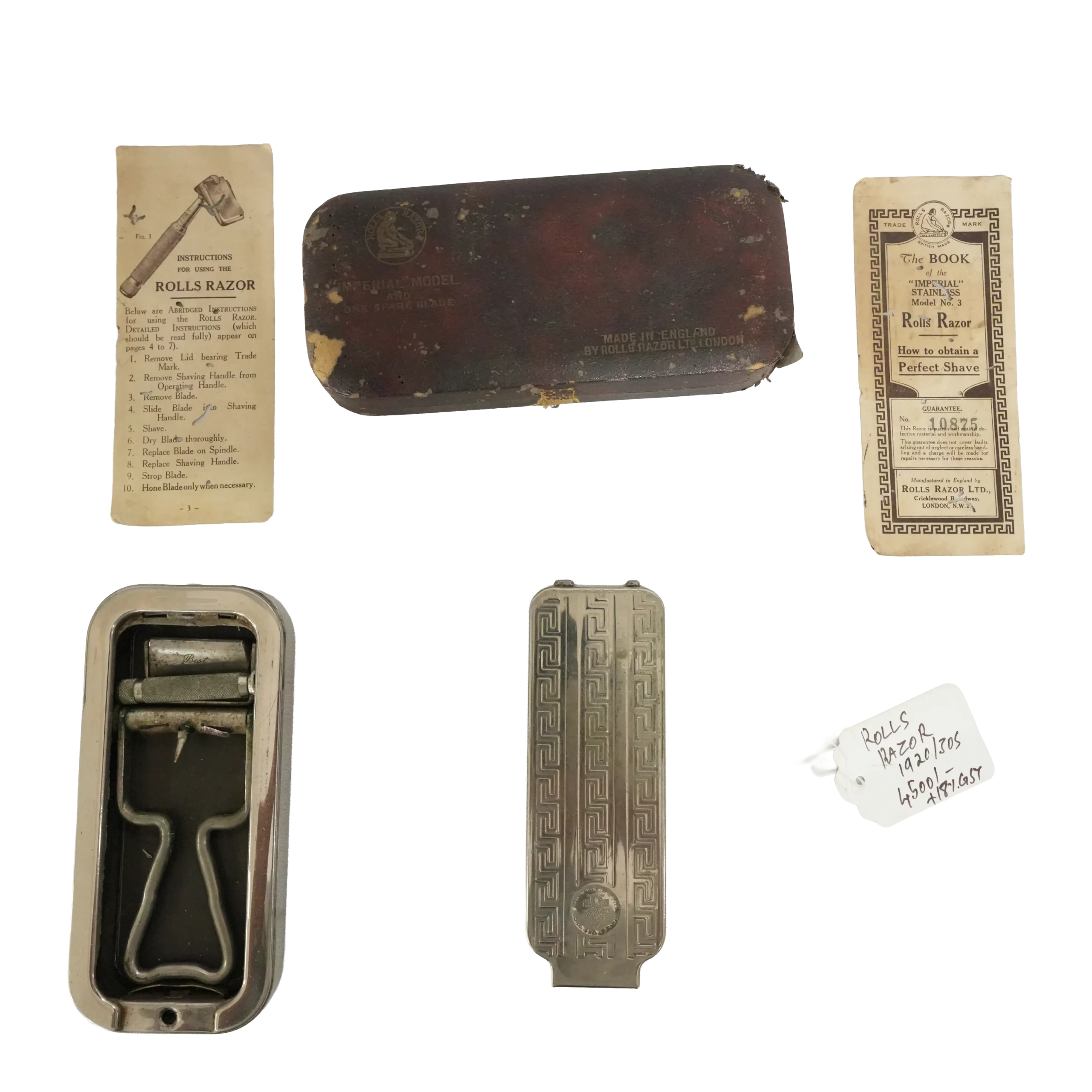
The Rolls Razor – Vintage Self-Stropping Safety Razor Set is a fine example of
early twentieth-century personal grooming technology, renowned for its innovative
design, durability, and elegant craftsmanship. Manufactured in England and
engraved with the inscription "Rolls Razor – Finest Stainless Steel," this complete
set includes a stainless steel safety razor, a detachable engraved blade cover, a
leather-covered metal storage case with the Rolls Razor name embossed in gold,
and the original instruction leaflet. Crafted from high-quality stainless steel with a
polished finish, the razor features a unique self-stropping and honing mechanism
built into the case, allowing the blade to be sharpened and maintained without the
need for external tools. Unlike disposable razors, the Rolls Razor was designed to
provide years of reliable service through regular stropping and occasional honing,
making it an economical and long-lasting grooming instrument. The blade cover is
decorated with an elegant Greek key pattern, reflecting the Art Deco style popular
during the period, while the original instruction leaflet adds significant historical and
archival value to the set. Manufactured by the British company Rolls Razor Limited,
the Rolls Razor gained popularity throughout the British Empire from the 1920s to
the 1960s.
During the colonial and post-colonial period in India, imported English
grooming products were regarded as symbols of refinement, modernity, and social
status, and were commonly owned by professionals, government officials, military
officers, and members of the urban elite. In Karnataka, where traditional barbers
known as Kshourika (ಕ್ಷೌರಿಕ) played an important role in society, high-quality personal
razors such as this were prized possessions often preserved and passed down
through generations. Today, the Rolls Razor stands as an important artifact
representing the evolution of personal grooming, industrial design, and precision
engineering. Preserving this complete set in a college museum enables visitors to
appreciate the craftsmanship, technological innovation, and cultural history
associated with personal care during the early twentieth century, while highlighting a
period when everyday objects were designed for durability, elegance, and lifelong
use.
