
Hanging Balance Scale
This is a traditional balance scale consisting of two metal pans suspended on chains from a horizontal beam, where goods to be weighed were placed in one pan and standard weights in the other, indicating equal weight when balanced; made of brass or bronze for durability and long-term use, it was a standard tool for goldsmiths, traders, and merchants before mechanical and electronic scales were introduced, with a simple yet effective design representing one of the oldest forms of weighing systems worldwide.
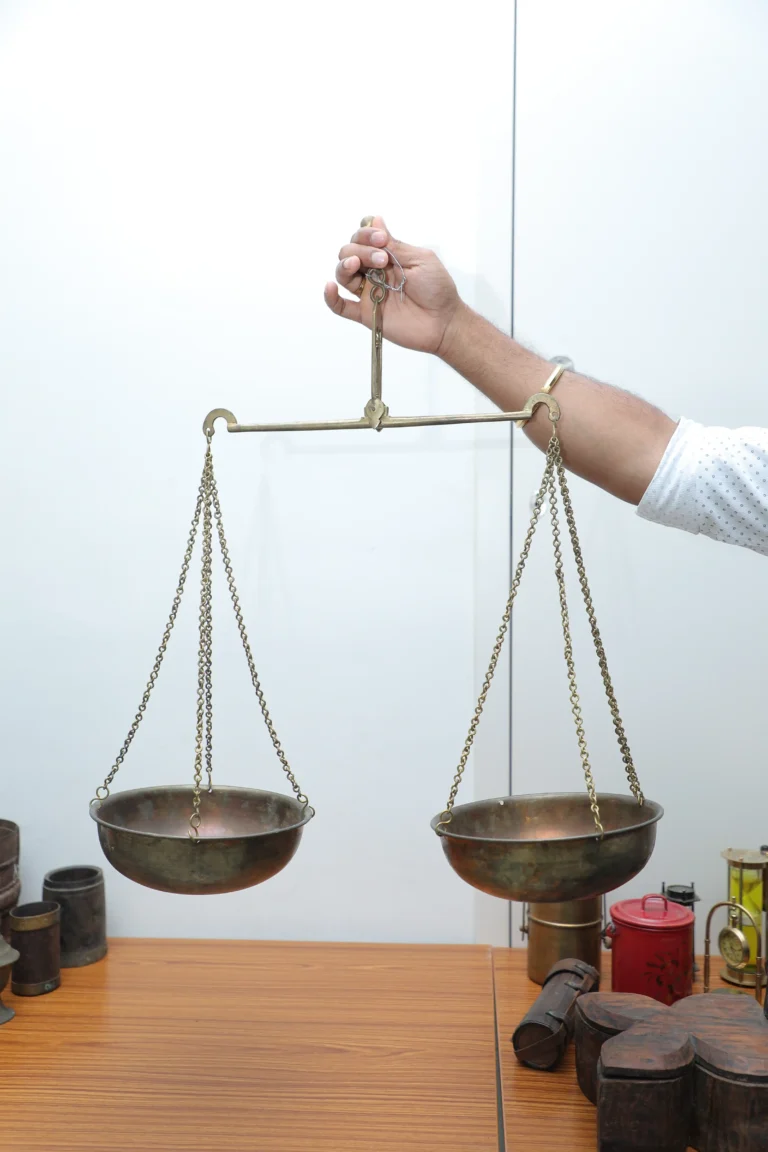
The weighing balance symbolizes fairness, balance, and justice, which is why it is also a universal emblem of law and equality; it played a vital role in trade, especially in bazaars, markets, and jewelry shops, and today is preserved as a heritage object representing honesty and traditional commerce.
Difference Between the Two Weighing Scales
| Feature | Mechanical Balance Scale | Hanging Balance Scale |
|---|---|---|
| Kannada Name | ತರವಾಣಿ / ತೂಕದ ತರವಾಣಿ (Taravaani / Tookada Taravaani) | ತೂಗು ತರವಾಣಿ (Toogu Taravaani) |
| Design | Fixed base with two pans (one flat, one bowl) attached to a beam, needle indicator in the center | Two hanging pans suspended by chains from a horizontal beam |
| Material | Mostly iron/steel body, with aluminum or metal pans | Brass or bronze (sometimes iron), fully metallic |
| How it Works | Goods placed in one pan, weights in the other; balance shown by needle pointer | Goods placed in one pan, weights in the other; balance shown by equal height of pans |
| Stability | Stable on a shop counter (does not swing much) | Moves freely while hanging; requires steady hand |
| Period of Use | Common in 20th century shops (provision stores, grocery shops) before electronic machines | Much older, used for centuries in bazaars, goldsmith shops, and rural markets |
| Accuracy | Slightly more accurate because of needle indicator | Depends on eye judgment of balance |
| Symbolism | Represents trade and marketplace practices | Symbol of justice, fairness, and honesty (used as an emblem in law and courts) |
