
ಬೀಸೋ ಕಲ್ಲು
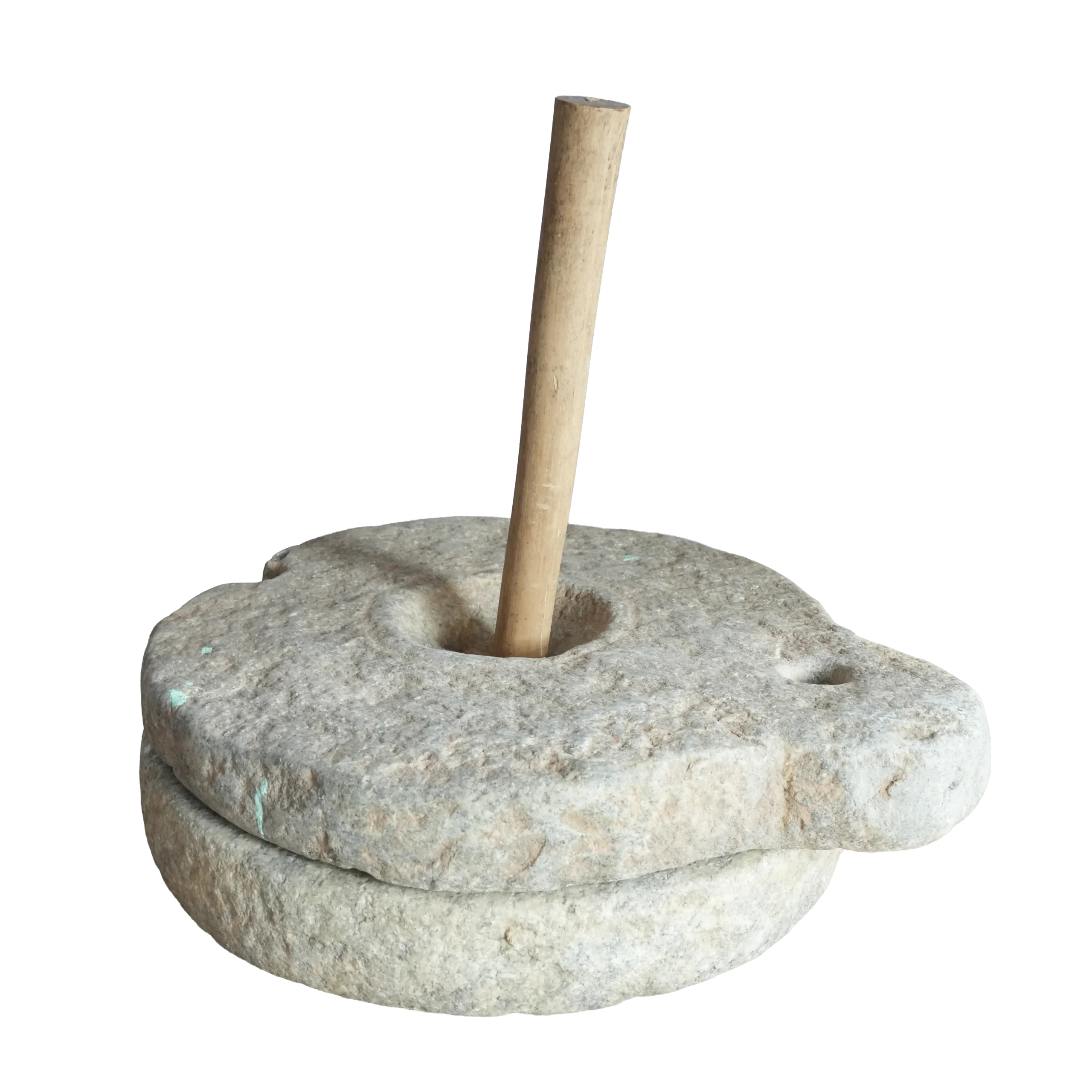
The Beeso Kallu is a traditional household stone implement used for dry grinding
and was once an indispensable feature of homes across Karnataka, particularly in
rural and agrarian communities. It consists of two thick circular granite stones placed
one above the other. The lower stone is a heavy circular slab of natural granite,
rough on the exterior but worn smooth on the grinding surface through years of use.
The upper stone, slightly smaller in diameter, fits over a central conical pivot that
allows it to rotate smoothly. It is fitted with a sturdy wooden handle inserted into a
hole near its outer edge, enabling the user to rotate the stone in a continuous circular
motion. A central opening serves as the grain-feeding hole through which grains are
poured during grinding. Carved from locally sourced granite, a dense and durable
rock ideally suited for repeated grinding, the implement reflects the practical
ingenuity of traditional craftsmanship. In northern India, this implement is commonly
known as a Chakki, meaning “stone mill,” while in Kannada the term Beeso Kallu
literally translates to “grinding stone,” with Beesu meaning “to grind dry” and Kallu
meaning “stone.”
Traditionally, the Beeso Kallu was used to grind rice, ragi (finger millet), wheat,
maize, pulses, and other grains into flour or coarse meal entirely by hand. Dry grains
were poured through the central opening of the upper stone, and as the user rotated
the stone using the wooden handle, the grains passed between the two grinding
surfaces and emerged as finely ground flour or coarse powder around the outer
edge. In addition to grains, the mill was commonly used for preparing chilli powder,
coriander powder, sambar powder, and other traditional spice blends. Because the
grinding process was slow and generated very little heat, it helped preserve the
natural nutrients, essential oils, aroma, and flavour of the ingredients, producing food
of superior quality compared with that processed by modern high-speed electric
grinders.
